



Introduction
If you have spent any meaningful time running workloads on Kubernetes, you have probably dealt with Ingress resources. They work. They get traffic into your cluster. But the moment you need something beyond basic host and path routing, you end up buried in controller-specific annotations that nobody else understands, that break the moment you switch controllers, and that give your application teams zero autonomy.
The Kubernetes Gateway API is the project’s answer to that problem. It is not just a newer version of Ingress. It is a fundamentally different way of thinking about traffic routing in a cluster, one that actually maps to how teams are structured and how infrastructure responsibility is divided.
This post walks through what Ingress could and could not do, why the Gateway API exists, what it looks like in practice with Nginx, AWS ALB, and the AWS Gateway API controller, and what just landed in v1.5 released on April 21, 2026.
The Ingress Problem
The Ingress spec itself is minimal by design. Out of the box, it gives you:
- Host-based routing
- Path-based routing
- TLS termination via a Kubernetes secret
That covers the basics, but anything beyond that required annotations. And annotations were where things got messy.
What annotations unlocked
Here is what you could do with the Nginx ingress controller using annotations:
Canary deployments:
nginx.ingress.kubernetes.io/canary: "true"
nginx.ingress.kubernetes.io/canary-weight: "20"
Redirects:
nginx.ingress.kubernetes.io/permanent-redirect: "https://new.example.com"
Path rewrites:
nginx.ingress.kubernetes.io/rewrite-target: /$2
Rate limiting:
nginx.ingress.kubernetes.io/limit-rps: "10"
Timeouts:
nginx.ingress.kubernetes.io/proxy-read-timeout: "60"
nginx.ingress.kubernetes.io/proxy-connect-timeout: "10"
And with the AWS ALB controller, the equivalent for weighted routing looked completely different:
alb.ingress.kubernetes.io/actions.forward-config: |
  {
    "targetGroups": [
      {"serviceName": "app-stable", "servicePort": 80, "weight": 80},
      {"serviceName": "app-canary", "servicePort": 80, "weight": 20}
    ]
  }
Same concept, completely different syntax, zero portability. If you switched controllers, you rewrote everything.
What was not possible at all
Some things were simply off the table regardless of which controller you used or how many annotations you stacked:
Cross-namespace routing. An Ingress resource can only route traffic to services in its own namespace. Full stop. If your gateway lived in infra and your app lived in payments, there was no clean way to connect them.
Meaningful multi-tenancy. There was no concept of “this team can manage routes for their hostname but cannot touch anyone else’s.” If an application team needed to add or change a route, they needed write access to the Ingress resource itself. That meant one team could accidentally overwrite another team’s routing rules.
Portable advanced routing. Header-based routing, traffic splitting, request mirroring, URL rewrites – all of these depended on annotations that were specific to the controller you happened to be running. Your YAML was tied to your infrastructure choice in a way that made migrations painful.
TCP and UDP routing. Ingress is an HTTP-only API. Routing raw TCP or UDP traffic required separate ConfigMap hacks that felt bolted on because they were.
What the Gateway API Changes
The Gateway API, now part of the official Kubernetes SIG Network project, was built around four principles: role-oriented, portable, expressive, and extensible.
The portable and expressive parts are straightforward. The interesting one is role-oriented.
A proper separation of responsibility
The Gateway API splits traffic routing across three resource types, each owned by a different persona in your organization.
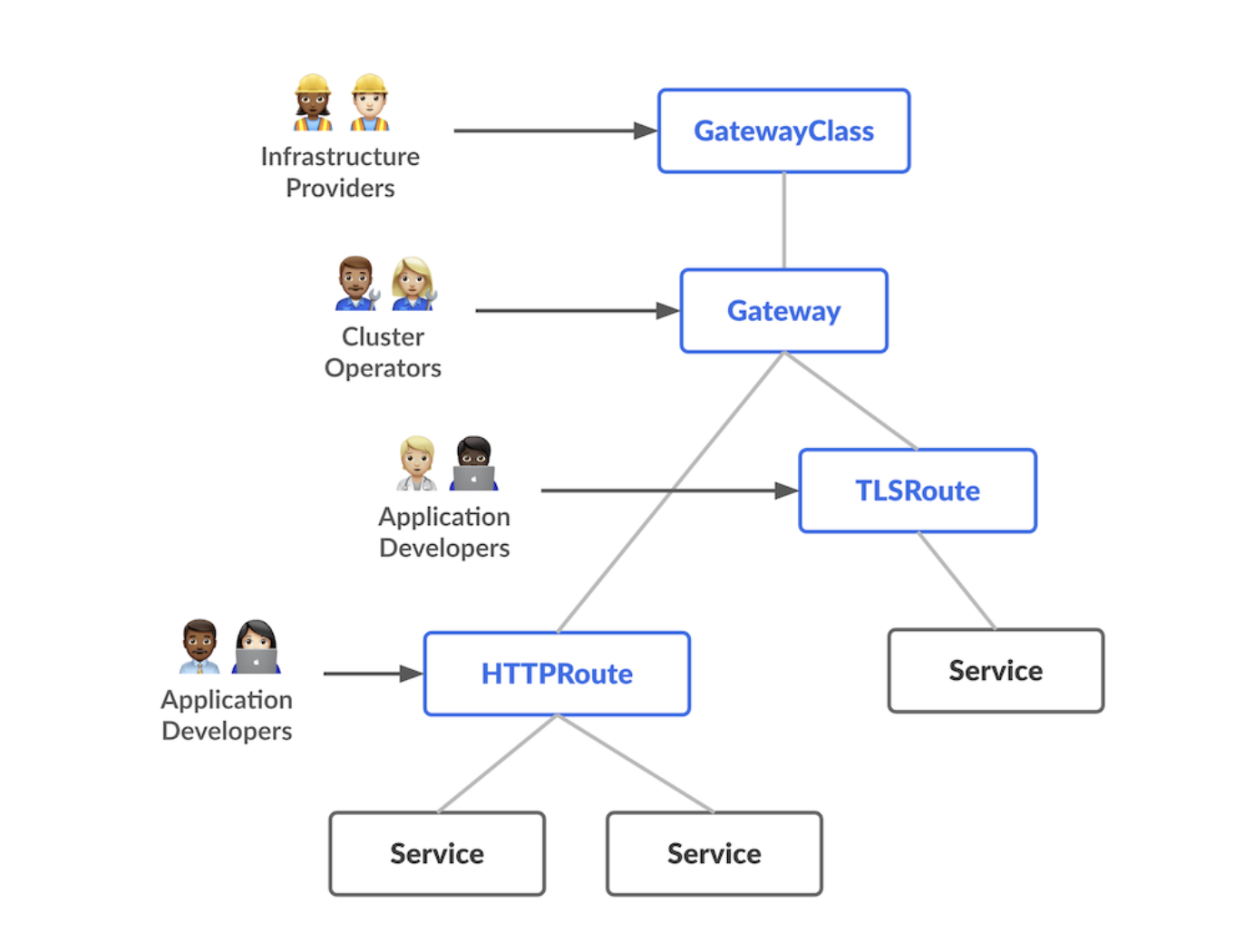
Infrastructure providers (think AWS, GCP, your platform team) manage GatewayClass. This is a cluster-scoped resource that defines which controller handles traffic, similar to StorageClass for persistent volumes.
Cluster operators manage Gateway. This is the actual load balancer or listener configuration. They decide which ports are open, which protocols are accepted, and which namespaces are allowed to attach routes.
Application developers manage HTTPRoute (or GRPCRoute, etc.). They define the routing rules for their specific application without ever touching the gateway itself.
This means an application team can deploy a new service and add a route to expose it without filing a ticket to the platform team. And the platform team can enforce policies at the Gateway level without blocking developers.
The standard API resources (v1.5)
Before jumping into examples, here is what is stable and production-ready in the standard channel as of v1.5, released April 21, 2026:
| Resource | API Version | Notes |
|---|---|---|
| GatewayClass | v1 | Stable |
| Gateway | v1 | Stable |
| HTTPRoute | v1 | Stable, now includes CORS filter |
| GRPCRoute | v1 | Stable |
| ReferenceGrant | v1beta1 | Stable |
| TLSRoute | v1alpha2 | Graduated to standard in v1.5 |
| ListenerSet | v1alpha2 | Graduated to standard in v1.5 |
TCP and UDP routes are still experimental. For most web workloads, the standard channel covers everything you need. And with v1.5 being the biggest release yet, the standard channel just got a lot more capable.
Before and After: Real YAML Examples
The Ingress way with Nginx
This is what a typical Nginx Ingress setup looks like. Basic routing works fine, but notice how the canary deployment requires a second Ingress object and controller-specific annotations:
# Main ingress
apiVersion: networking.k8s.io/v1
kind: Ingress
metadata:
  name: my-app
  namespace: production
  annotations:
    kubernetes.io/ingress.class: nginx
    nginx.ingress.kubernetes.io/proxy-read-timeout: "60"
spec:
  tls:
    - hosts:
        - app.example.com
      secretName: app-tls
  rules:
    - host: app.example.com
      http:
        paths:
          - path: /
            pathType: Prefix
            backend:
              service:
                name: app-stable
                port:
                  number: 80
---
# Canary ingress -- separate object, same host
apiVersion: networking.k8s.io/v1
kind: Ingress
metadata:
  name: my-app-canary
  namespace: production
  annotations:
    kubernetes.io/ingress.class: nginx
    nginx.ingress.kubernetes.io/canary: "true"
    nginx.ingress.kubernetes.io/canary-weight: "20"
spec:
  rules:
    - host: app.example.com
      http:
        paths:
          - path: /
            pathType: Prefix
            backend:
              service:
                name: app-canary
                port:
                  number: 80
It works, but splitting one logical routing concern across two resources with annotations controlling the relationship is not great. And this only works with Nginx. Switch to ALB and you start over.
The Ingress way with AWS ALB controller
The ALB controller uses a completely different annotation vocabulary:
apiVersion: networking.k8s.io/v1
kind: Ingress
metadata:
  name: my-app
  namespace: production
  annotations:
    kubernetes.io/ingress.class: alb
    alb.ingress.kubernetes.io/scheme: internet-facing
    alb.ingress.kubernetes.io/target-type: ip
    alb.ingress.kubernetes.io/certificate-arn: arn:aws:acm:us-east-1:123456789:certificate/abc123
    alb.ingress.kubernetes.io/listen-ports: '[{"HTTPS":443}]'
    alb.ingress.kubernetes.io/actions.weighted-routing: |
      {
        "type": "forward",
        "forwardConfig": {
          "targetGroups": [
            {"serviceName": "app-stable", "servicePort": 80, "weight": 80},
            {"serviceName": "app-canary", "servicePort": 80, "weight": 20}
          ]
        }
      }
spec:
  rules:
    - host: app.example.com
      http:
        paths:
          - path: /
            pathType: Prefix
            backend:
              service:
                name: weighted-routing  # references the annotation action
                port:
                  name: use-annotation
The annotation-as-action pattern is particularly awkward here. The backend service name is literally weighted-routing, referencing an annotation key. This is not standard Kubernetes, and anyone reading this for the first time has no idea what is happening.
The Gateway API way with Nginx Gateway Fabric
Now here is the same setup using the Gateway API with the Nginx Gateway Fabric controller. The platform team manages the GatewayClass and Gateway. The application team only touches HTTPRoute.
# Platform team owns this
apiVersion: gateway.networking.k8s.io/v1
kind: GatewayClass
metadata:
  name: nginx
spec:
  controllerName: gateway.nginx.org/nginx-gateway-controller
---
# Platform team owns this too
apiVersion: gateway.networking.k8s.io/v1
kind: Gateway
metadata:
  name: main-gateway
  namespace: infra
spec:
  gatewayClassName: nginx
  listeners:
    - name: https
      port: 443
      protocol: HTTPS
      tls:
        mode: Terminate
        certificateRefs:
          - name: app-tls
            namespace: infra
      allowedRoutes:
        namespaces:
          from: Selector
          selector:
            matchLabels:
              gateway-access: "true"
---
# Application team owns this -- different namespace
apiVersion: gateway.networking.k8s.io/v1
kind: HTTPRoute
metadata:
  name: my-app
  namespace: production
spec:
  parentRefs:
    - name: main-gateway
      namespace: infra
  hostnames:
    - app.example.com
  rules:
    - matches:
        - path:
            type: PathPrefix
            value: /
      backendRefs:
        - name: app-stable
          port: 80
          weight: 80
        - name: app-canary
          port: 80
          weight: 20
Traffic weighting is a first-class field, not an annotation. The application team writes a clean HTTPRoute in their own namespace. The platform team controls what namespaces can attach via the allowedRoutes selector. Nobody needs to coordinate on every change.
To allow the cross-namespace reference from production to infra, you add a ReferenceGrant:
apiVersion: gateway.networking.k8s.io/v1beta1
kind: ReferenceGrant
metadata:
  name: allow-production-routes
  namespace: infra
spec:
  from:
    - group: gateway.networking.k8s.io
      kind: HTTPRoute
      namespace: production
  to:
    - group: ""
      kind: Secret
      name: app-tls
The Gateway API way with AWS (Gateway API controller for AWS)
AWS has a Gateway API controller that uses an Application Load Balancer as the underlying implementation. The setup follows the same pattern – the only thing that changes is the GatewayClass and some AWS-specific fields.
# Installed by AWS when you set up the controller
apiVersion: gateway.networking.k8s.io/v1
kind: GatewayClass
metadata:
  name: aws-alb
spec:
  controllerName: gateway.k8s.aws/alb
---
# Platform team configures the ALB
apiVersion: gateway.networking.k8s.io/v1
kind: Gateway
metadata:
  name: alb-gateway
  namespace: infra
  annotations:
    gateway.alb.k8s.aws/scheme: internet-facing
    gateway.alb.k8s.aws/target-type: ip
    gateway.alb.k8s.aws/certificate-arn: arn:aws:acm:us-east-1:123456789:certificate/abc123
spec:
  gatewayClassName: aws-alb
  listeners:
    - name: https
      port: 443
      protocol: HTTPS
      tls:
        mode: Terminate
        certificateRefs:
          - name: app-tls
            namespace: infra
      allowedRoutes:
        namespaces:
          from: Selector
          selector:
            matchLabels:
              gateway-access: "true"
---
# Application team deploys this -- identical structure to the Nginx example
apiVersion: gateway.networking.k8s.io/v1
kind: HTTPRoute
metadata:
  name: my-app
  namespace: production
spec:
  parentRefs:
    - name: alb-gateway
      namespace: infra
  hostnames:
    - app.example.com
  rules:
    - matches:
        - path:
            type: PathPrefix
            value: /api
          headers:
            - name: X-Version
              value: v2
      backendRefs:
        - name: app-v2
          port: 8080
    - matches:
        - path:
            type: PathPrefix
            value: /
      backendRefs:
        - name: app-stable
          port: 80
          weight: 80
        - name: app-canary
          port: 80
          weight: 20
Notice that the HTTPRoute is identical to the Nginx example. The application team does not know or care whether the underlying load balancer is Nginx or an AWS ALB. That is the portability the Gateway API was designed to deliver.
Installing the Gateway API CRDs
The Gateway API is not bundled with Kubernetes itself. You install it separately as CRDs:
# Standard channel (recommended for production) -- v1.5 is the latest stable
kubectl apply -f https://github.com/kubernetes-sigs/gateway-api/releases/download/v1.5.0/standard-install.yaml

# Experimental channel (adds TCPRoute, UDPRoute, and more)
kubectl apply -f https://github.com/kubernetes-sigs/gateway-api/releases/download/v1.5.0/experimental-install.yaml
After that, you install your specific controller (Nginx Gateway Fabric, AWS Gateway API controller, Cilium, Envoy Gateway, etc.) which registers itself as a GatewayClass.
What Just Changed in Gateway API v1.5
Gateway API v1.5 dropped on April 21, 2026, and the team described it as the biggest release yet. The theme is graduation: six features moved from experimental to standard, meaning they are now production-ready and stable.
ListenerSet
This is the most significant addition for anyone running multi-tenant clusters. Before ListenerSet, a Gateway could only hold listeners defined within its own spec. That created a hard coordination problem: if the platform team owns the Gateway and app teams need to add listeners for their own hostnames, someone has to file a ticket and wait.
ListenerSet solves this by letting listeners be defined in separate resources that attach to a parent Gateway, similar to how HTTPRoute attaches to a Gateway. Each team can manage their own ListenerSet in their own namespace, and the Gateway merges them all together.
apiVersion: gateway.networking.k8s.io/v1alpha2
kind: ListenerSet
metadata:
  name: payments-listeners
  namespace: payments
spec:
  parentRef:
    name: main-gateway
    namespace: infra
  listeners:
    - name: payments-https
      hostname: payments.example.com
      port: 443
      protocol: HTTPS
      tls:
        mode: Terminate
        certificateRefs:
          - name: payments-tls
This also removes a practical limitation: a single Gateway was previously capped at 64 listeners. With ListenerSet, large shared gateways can scale well past that.
TLSRoute
TLSRoute graduated to standard in v1.5. As covered earlier, this is for SNI-based passthrough routing where the encrypted traffic goes directly to the backend without the gateway terminating TLS. Most applications should still use TLS termination at the gateway with HTTPRoute, but for databases, mTLS-required services, and legacy apps that own their own certs, TLSRoute is now stable and production-ready.
HTTPRoute CORS Filter
CORS policy configuration is now a first-class field in the standard channel. Before this, handling CORS headers required either custom plugins or nginx configuration snippets via annotations.
filters:
  - type: ExtensionRef
    extensionRef:
      group: gateway.networking.k8s.io
      kind: HTTPRoute
  - type: ResponseHeaderModifier
    responseHeaderModifier:
      set:
        - name: Access-Control-Allow-Origin
          value: "https://app.example.com"
Client Certificate Validation
Validating client certificates during mTLS connections is now stable. This is important for service-to-service authentication patterns where the gateway enforces that only clients presenting a valid cert can reach a backend.
What this release signals
The v1.5 release also introduced a new release train model, borrowed from how the Kubernetes project itself ships. Features now cut on a freeze date rather than whenever they happen to be ready. That means more predictable releases and less time waiting for a feature to land in stable.
If you are evaluating Gateway API for a production cluster, v1.5 is the release where the answer to “is this ready?” is clearly yes.
What This Means Practically
If you are running a small single-team cluster, the difference between Ingress and Gateway API is mostly syntax. Both get the job done.
The real value shows up at scale. When you have multiple teams sharing a cluster, when you need to enforce that the platform team controls the load balancer config but app teams control their own routes, when you want to do a canary rollout without touching the gateway configuration, when you need to move between cloud providers or controllers without rewriting all your routing config – that is where the Gateway API’s design actually pays off.
The official spec describes it as balancing “distributed flexibility and centralized control.” That is a reasonable summary. Application developers get the autonomy to manage their own routes. Platform teams keep control of the infrastructure. And the routing configuration itself is portable across any compliant implementation.
Ingress got Kubernetes networking to where it needed to be in the early years. Gateway API is where it needs to go next.